
Amid increasingly strict market requirements for food quality and safety, the livestock sector in the southern localities of Thai Nguyen Province is undergoing a strong transformation. Key communes such as Tan Thanh, Tan Khanh, Kha Son, and Phu Binh are accelerating the application of science and technology, helping increase production value and create sustainable livelihoods.
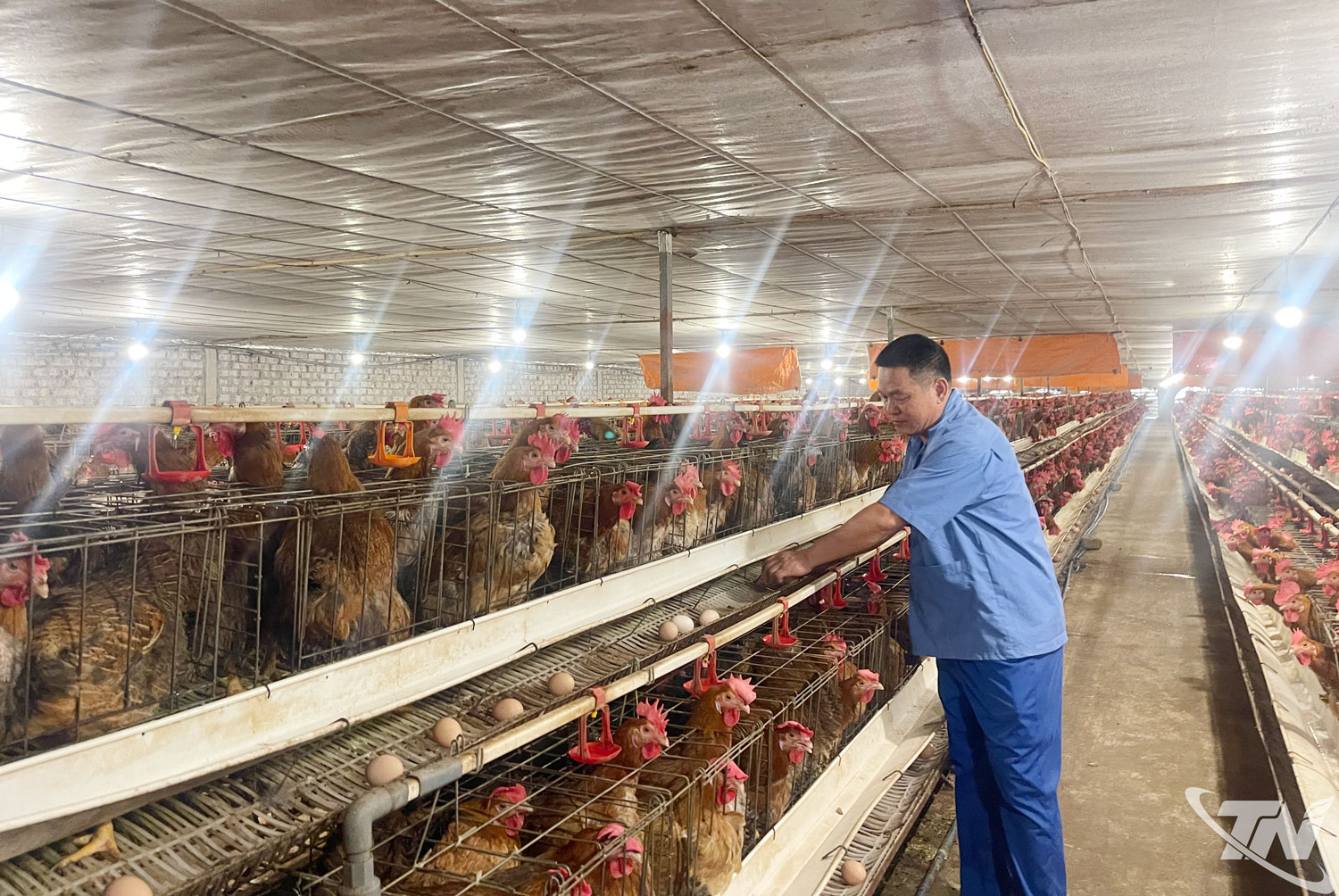 |
| The chicken breeding model of Mr. Duong Dinh Son. |
In recent years, many households in Kha Son Commune have focused on developing livestock farming and supplying chicken breeds to the market. All stages of production have been carried out under biosecurity standards combined with the application of technical advances to improve quality. Farmers have boldly invested in closed farming systems covering thousands of square meters. Each batch includes 7,000 to 8,000 broiler chickens, while many households supply 10,000 to 12,000 chicks per batch. Thanks to these poultry farming models, many families earn over VND 1 billion per year.
Mr. Duong Dinh Son in Pham 1 Hamlet, Kha Son Commune, said: “I run a closed process, from raising hens for eggs to incubation and hatching chicks, then selling the chicks. My family’s model operates continuously throughout the year.”
Alongside traditional livestock, raising white horses in Kha Son is emerging as a promising direction. The family of Duong Van Nang in Giang Hamlet is among those operating on a relatively large scale while applying technical measures in breeding. On average, his stable holds 20 to 30 horses, and at peak times up to nearly 100. Each white horse is priced at around VND 70 to 80 million. The family’s annual income reaches between VND 1.5 and 2 billion. He is also a member of the Pham Hamlet White Horse Cooperative, which has 54 members specializing in supplying horse-based products. The cooperative not only provides stable jobs and income for local people but also helps build a distinct brand for the area.
"The stables must be kept clean, the feed must be hygienic, and both the water supply and wastewater systems must be connected to a biogas system. This helps protect the environment and ensures the horses grow strong and healthy," said Mr. Duong Van Nang in Giang Hamlet, Kha Son Commune.
 |
| The white horse farming model of Mr. Duong Van Nang. |
Meanwhile, in Tan Khanh Commune, cooperatives and livestock households have actively applied science and technology in farming. Professionalism at every stage, from production to consumption, has helped local products maintain their position and expand in the market. In addition, technical staff regularly work with farmers, guiding them on biosecure farming processes and the use of microbial products, gradually changing traditional practices.
Ms. Ngo Hong Theu, an officer at the Economic Division of Tan Khanh Commune, noted: “We regularly organize training courses to introduce farmers to science and technology, the use of biological bedding, biological products, and probiotics in livestock farming.”
To promote these models, local authorities have strengthened policy support, creating favorable conditions for people to expand livestock production.
Ms. Tran Thi Tuyen, Chairwoman of the Tan Khanh Commune People’s Committee, stressed: “In livestock farming, biosecurity must be ensured. Vaccinations must be administered on schedule, and farmers also need to proactively secure vaccine supplies so that animals remain healthy, develop well, prevent disease outbreaks, and achieve the highest economic efficiency.”
To date, Thai Nguyen Province has more than 1,600 farms, including 80 large-scale farms, 786 medium-scale farms, and 753 small-scale farms. Most large and medium farms operate under closed farming systems. With positive results from applying science and technology, livestock farming models in southern Thai Nguyen are gradually proving their effectiveness, opening up sustainable economic development opportunities for residents.



Thông tin bạn đọc
Đóng Lưu thông tin